
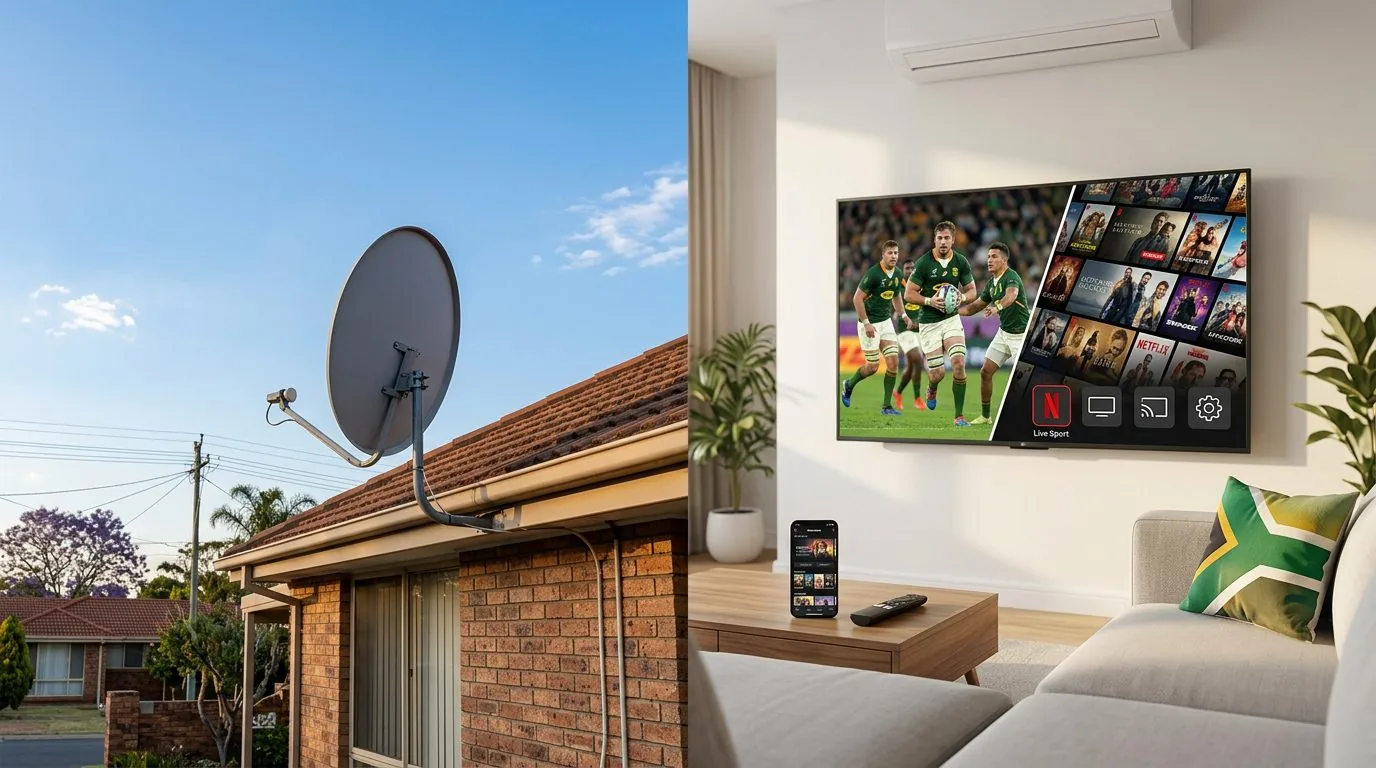
DStv vs IPTV: The Real Cost Comparison for South Africa (2026)
Every month, millions of South African households watch the debit order for their TV subscription leave their account and quietly wonder if there's a cheaper way to watch the football, the soapies and the latest series. DStv has been the default answer for decades. But streaming has changed what people expect to pay, and a lot of viewers are now weighing up an IPTV subscription against the satellite bouquet they've had since forever.
This guide breaks down the actual cost of both, side by side, in rands. We'll be honest about where DStv still wins and where it doesn't, and we'll show you exactly what our IPTV plans cost so you can do the maths for your own home. No spin, no inflated channel counts, just the numbers and the trade-offs.
What DStv Packages Cost in South Africa
DStv sells access in tiers, and the price gap between the bottom and the top of the range is large. The exact rand figures shift a little each year with the annual price adjustment, so treat these as the well-known ballparks rather than to-the-cent quotes.
- DStv Premium sits at the top. It's the bouquet most people think of when they picture "full" DStv, with the widest sport, movie and series line-up. It typically lands around R900 a month or more, which makes it the most expensive consumer TV product in the country.
- DStv Compact Plus is the middle-upper option. It carries most of the popular sport and entertainment channels but trims some of the premium movie content. You're generally looking at a few hundred rand below Premium.
- DStv Compact is the mid-tier family bouquet, popular with households that want the soapies, kids' channels and some sport without the Premium price. It's noticeably cheaper than Compact Plus.
- Lower bouquets like Family, Access and EasyView drop the price further, but they also drop most of the live sport and a chunk of the marquee channels, which is exactly what many subscribers are paying for.
On top of the bouquet fee, remember the once-off costs that don't show on the monthly comparison: the decoder, the dish, installation and, if you want recording or multi-room, the extra hardware and access fees. Those add up before you've watched a single match.
What IPTV Costs With Us
Our pricing is simple and it's the same whether you watch on a TV, a phone or a laptop. No decoder to buy, no dish on the roof, no installer appointment. Here are the real plans:
- 1 Month: R399
- 3 Months: R599 (works out to roughly R200 a month)
- 6 Months: R849 (roughly R142 a month)
- 12 Months: R1299 (roughly R108 a month)
The longer the plan, the lower your effective monthly cost. A household that commits to a year pays about R108 a month, which is a fraction of what a top DStv bouquet costs over the same period. That single number is why so many people start looking at IPTV in the first place.
It's also worth being clear about what you don't pay for: there's no hardware bill, no installation fee, and no separate charge to watch on a second screen in another room. You stream over your existing internet connection on devices you already own.
If you want to read the full plan details and what's included, see our IPTV subscription page before you decide.
The Real Comparison, Point by Point
Price is only half the story. Here's how the two stack up across the things that actually matter day to day.
| Factor | DStv | IPTV (Us) |
|---|---|---|
| Top-tier monthly price | Around R900+ for Premium | R399 once-off month, or about R108/month on the annual plan |
| Hardware | Decoder + dish + installation needed | None needed; use your phone, smart TV, box or laptop |
| Contract | Month-to-month, but with hardware and setup sunk costs | Pay only for the period you choose, no lock-in |
| Sport rights | Holds many exclusive local and international rights | Wide live sport coverage, but no guaranteed exclusive rights |
| Local content | Strong; funds and airs local productions and channels | Available, but local-original investment isn't its strength |
| Devices & multi-room | Extra access fees for more screens | Watch across your devices without extra per-screen charges |
| Reliability | Very stable; weather can affect the satellite signal | Depends on your internet speed and stability |
| Customer service | Established call centres and walk-in support | Online support; varies by provider |
A few of these deserve a fair hearing rather than a one-line summary.
Where DStv Genuinely Wins
Let's not pretend DStv is just an overpriced relic. There are real reasons it still has the subscribers it does.
Local production. DStv and its channels pour money into South African shows, sport productions and local-language content. That ecosystem supports jobs and creates programming you simply won't find produced anywhere else. If you watch a lot of local soapies, local sport coverage with local commentary, or home-grown reality and drama, that matters.
Guaranteed rights. When DStv holds the rights to a major tournament or league, you know the match will be there, in full, on time. That certainty has value, especially for big sporting events the whole household plans around.
Customer service and stability. There's a call centre, there are physical agents, and the satellite signal is rock-solid as long as the weather behaves. For someone who wants TV that just works and a number to phone when it doesn't, that's worth paying for.
Where IPTV Wins, and the Trade-Offs
The pull of IPTV is obvious once you've seen the prices, but be honest with yourself about the catches too.
The win: dramatically lower monthly cost, no hardware to buy, no installer to wait for, and the freedom to watch on whatever device is in your hand. You're not signing anything long-term, and you can watch in the bedroom and the lounge without paying a multi-room fee.
The trade-off: IPTV lives and dies by your internet. If your connection is slow or drops often, your viewing suffers, and there's no satellite to fall back on. IPTV providers also don't hold exclusive broadcast rights the way DStv does, so the experience isn't backed by the same legal guarantees. Service quality varies a lot between providers, so the one you choose makes a real difference. If you're unsure about the rules around all this, we cover it plainly in our guide on whether IPTV is legal in South Africa.
Thinking about making the move? See our IPTV plans and pick the one that fits your home. You can start with a single month and decide from there.
Who Should Pick Which
There's no single right answer, so here's the honest version.
- Stick with DStv if you watch a lot of local productions, you want guaranteed rights to specific tournaments, your internet is unreliable, or you value a traditional call-centre safety net and a signal that doesn't depend on data.
- Move to IPTV if your monthly TV bill has become hard to justify, you have a stable internet connection, you watch across phones and tablets as much as the big screen, and you'd rather pay closer to R100–R200 a month than R900.
- Run both for a while if you're not ready to cut the cord cold. Plenty of households downgrade their DStv bouquet and add an affordable IPTV plan to fill the gaps, then cancel the satellite once they're comfortable.
For a deeper feature-by-feature look beyond just cost, our IPTV vs DStv comparison goes further than this page does.
How to Switch From DStv to IPTV
The change is less of a hassle than people expect. Here's the straightforward path.
- Check your internet. A stable fibre or solid LTE connection makes IPTV smooth. Test your speed and how often it drops before you commit.
- Pick a plan. Start with the 1-month R399 option if you want to test the waters, or save with the 6 or 12-month plan once you're sure.
- Use the devices you own. Your smart TV, a small streaming box, your phone or your laptop will do the job. No new dish, no installer.
- Overlap, then cancel. Keep DStv running for your first week or two of IPTV so you're never without TV. Once you're happy, downgrade or cancel the satellite bouquet.
- Tell the household. Show everyone how to open the app and find their channels so the switch sticks and nobody's left fiddling with the remote.
Ready to compare your own numbers? Head back to our home page to see everything we offer, or jump straight to the subscription plans.
Frequently Asked Questions
Is IPTV really cheaper than DStv? For most households, yes, and by a wide margin. A top DStv bouquet runs around R900 or more a month, while our annual IPTV plan works out to roughly R108 a month. Even our flexible single month at R399 sits below the premium satellite tiers.
Will I need to buy any hardware for IPTV? No. You stream on devices you already own, like a smart TV, phone, laptop or a small media box. There's no decoder, no dish and no installation appointment, which removes the once-off costs that come with a new DStv setup.
Does IPTV work without good internet? Not well. IPTV depends entirely on your connection, so a slow or unstable line will cause buffering. If your internet is patchy, DStv's satellite signal is the more dependable choice. Test your speed before you switch.
Can I keep DStv and try IPTV at the same time? Absolutely, and many people do exactly that. Downgrade your DStv bouquet to a cheaper tier, add an affordable IPTV plan, and run both until you're confident enough to cancel the satellite.
Does IPTV cover live sport? Yes, IPTV offers wide live sport coverage. The difference is that IPTV providers don't hold the exclusive broadcast rights DStv often does, so for certain marquee events the guaranteed, rights-backed option remains satellite.
Is it legal to use IPTV in South Africa? The short answer is that it depends on the service and the content. We explain the nuances in our dedicated guide on IPTV and the law in South Africa, which is worth a read before you sign up to anything.